

Selling Value, Not Price:
A Consultative Approach
Overview
Audience
New and experienced members of a business-to-business sales team at large industrial equipment supplier.
Role
Needs Analysis Instructional Design Visual Design Prototype Creation Full Development
Tools Used
Storyline 360 PowerPoint Mindmeister Scrivener Midjourney
The Problem
FluoroTech is a fictional global leader in the formulation, development and compounding of premium high-performance materials for the aerospace, medical and semiconductor processing markets. Recently, the company expanded its sales team to drive growth and capture new market opportunities. However, despite this expansion, FluoroTech has observed a troubling trend: a growing reliance on discounts to close sales, and an overall decrease in percentage of closed sales. Additionally, the company has seen a decline in customer referrals, forcing a heavier reliance on new customer acquisition efforts, which are both costly and time-consuming.
At the same time, the cost of research and development (R&D) to meet customer-specific formulation requirements has risen, further squeezing margins. Leadership is growing increasingly concerned that these challenges are eroding FluoroTech’s reputation as an innovation leader in the industry. To maintain its competitive edge, the company aims to improve customer retention, reduce R&D costs, and equip its sales team with the skills needed to sell on value rather than price. Addressing these issues will be critical to sustaining profitability, strengthening brand loyalty, and reinforcing FluoroTech’s position as a leader in advanced industrial materials.
Needs Analysis
I collaborated with stakeholders and subject matter experts to identify key performance indicators (KPIs) for measuring progress toward the company’s goals. Among the KPIs considered, opportunity win rate—calculated as (Won opportunities / Total qualified opportunities) × 100—was identified as the most critical metric.
Additionally, Customer Lifetime Value (CLV) and Customer Acquisition Cost (CAC) were recognized as important long-term supporting metrics. An increase in CLV would signal strong, lasting customer relationships, while a decrease in CAC would suggest that new opportunities are being generated efficiently through referrals.
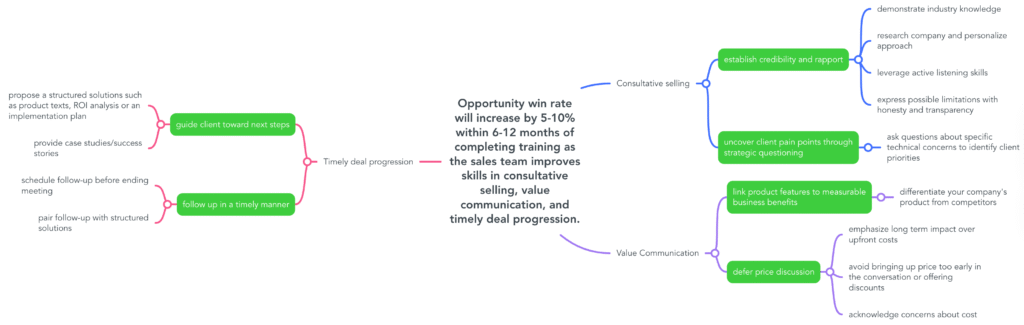
The following organizational goal was established: Opportunity win rate will increase by 5-10% within 6-12 months of implementing the solution as salespeople improve their skills in consultative selling, value communication, and timely deal progression.
Using the technique of action mapping, I worked with a subject matter expert to identify the high-priority actions that salespeople would need to take in order to improve win rate while strengthening relationships with customers and increasing brand reputation.
The Solution
I proposed a self-paced, scenario-based eLearning course that allows salespeople to practice the skills needed to achieve Fluoro-Tech’s goals. eLearning was determined to be an effective solution for several reasons:
- It provides a risk-free environment for the sales team to practice customer interactions.
- It offers flexibility for sales teams across different regions and branches.
- It not only addresses the current challenge but also serves as an ongoing training tool for new salespeople.
- It can be tailored to meet the needs of salespeople with varying levels of experience and skill.
In addition to developing the eLearning course, I recommended the following steps to further support and strengthen the sales team’s skills:
- An ongoing training program focused on both industry insights and product knowledge. This program should include regular industry updates, deep dives into product applications, and comparison of FluoroTech’s offerings with competitors.
- Implementing in-person role-playing activities between peers to reinforce the skills practiced in the eLearning course.
- Arranging meetings with experienced sales leaders to discuss progress and refine strategies for customer interactions.
I wrote five Learning Objectives to guide design and development of the course. In the course, learners will:
- Establish credibility and rapport by demonstrating industry knowledge and understanding client needs.
- Uncover client pain points through strategic questioning, focusing on performance and efficiency rather than price.
- Communicate value effectively by linking product features to measurable business benefits.
- Defer price discussions strategically to emphasize long-term impact over upfront costs.
- Guide the client toward a next step by proposing a structured solution, such as a product test or data review.
Text-Based Storyboard
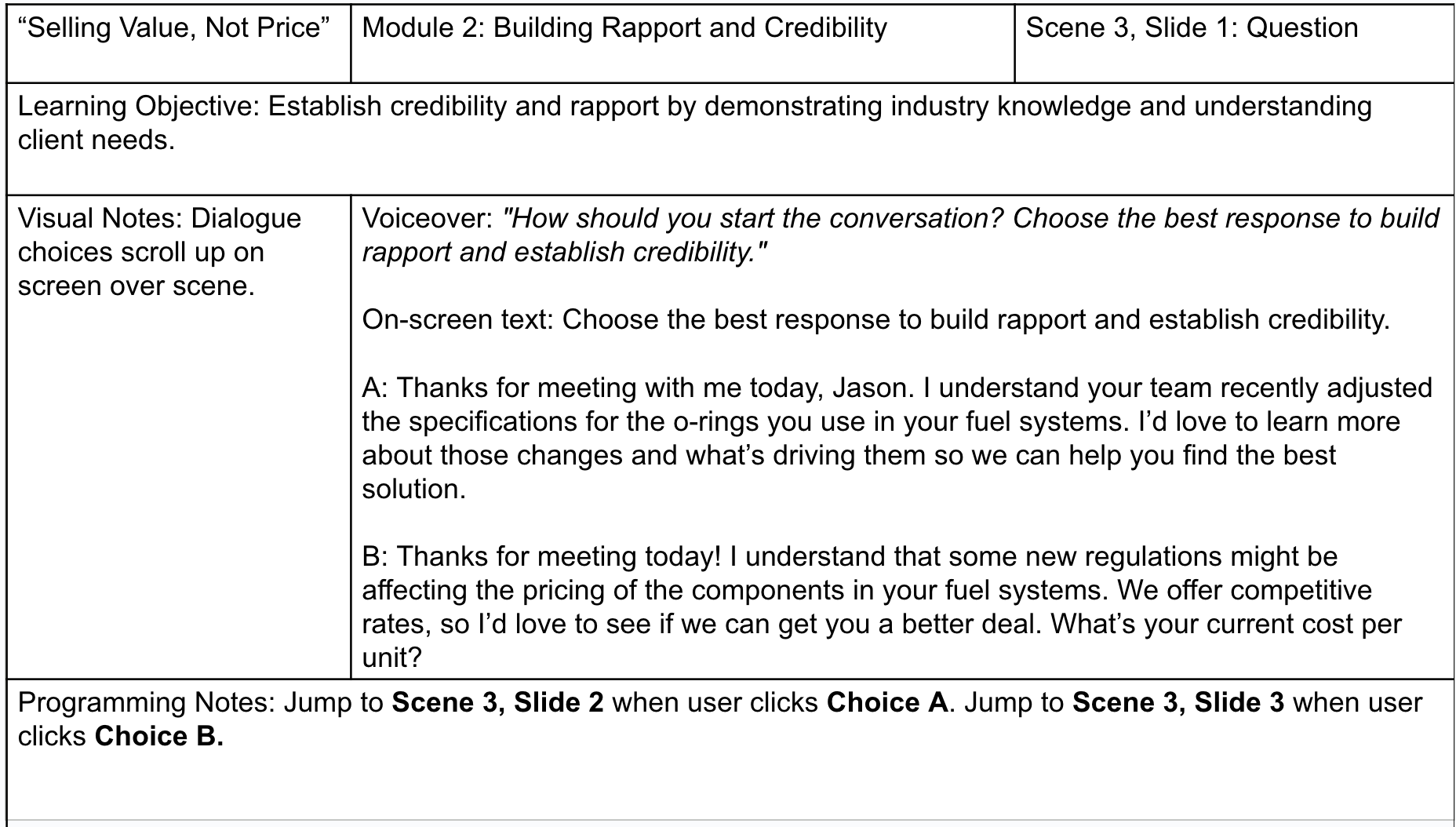
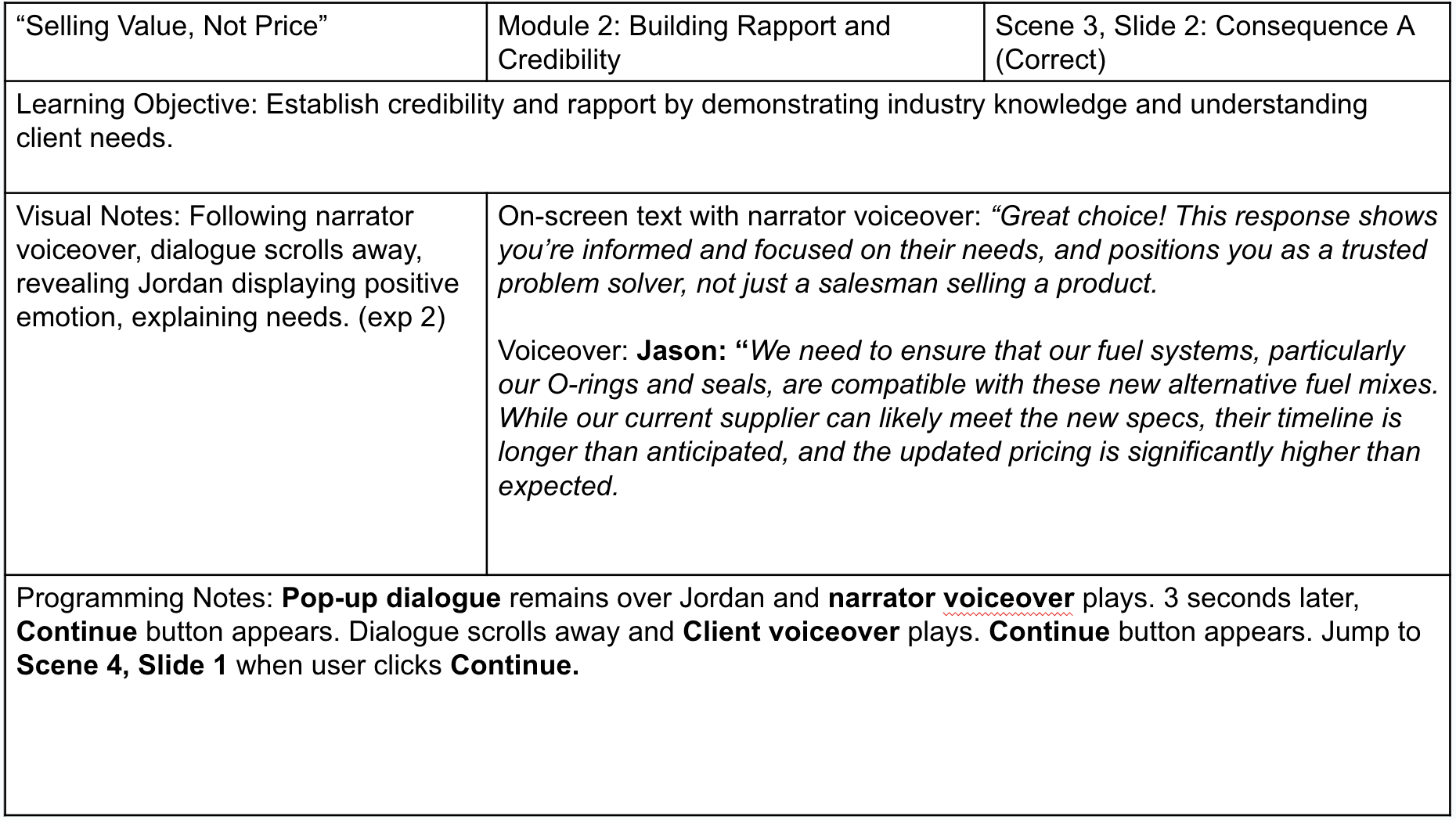
Next, I created a text-based storyboard and drafted a scenario for the first of the five learning objectives. In collaboration with a subject matter expert (SME) from the industry, I developed a script that captured a realistic, conversational exchange between a salesperson and a prospective buyer.
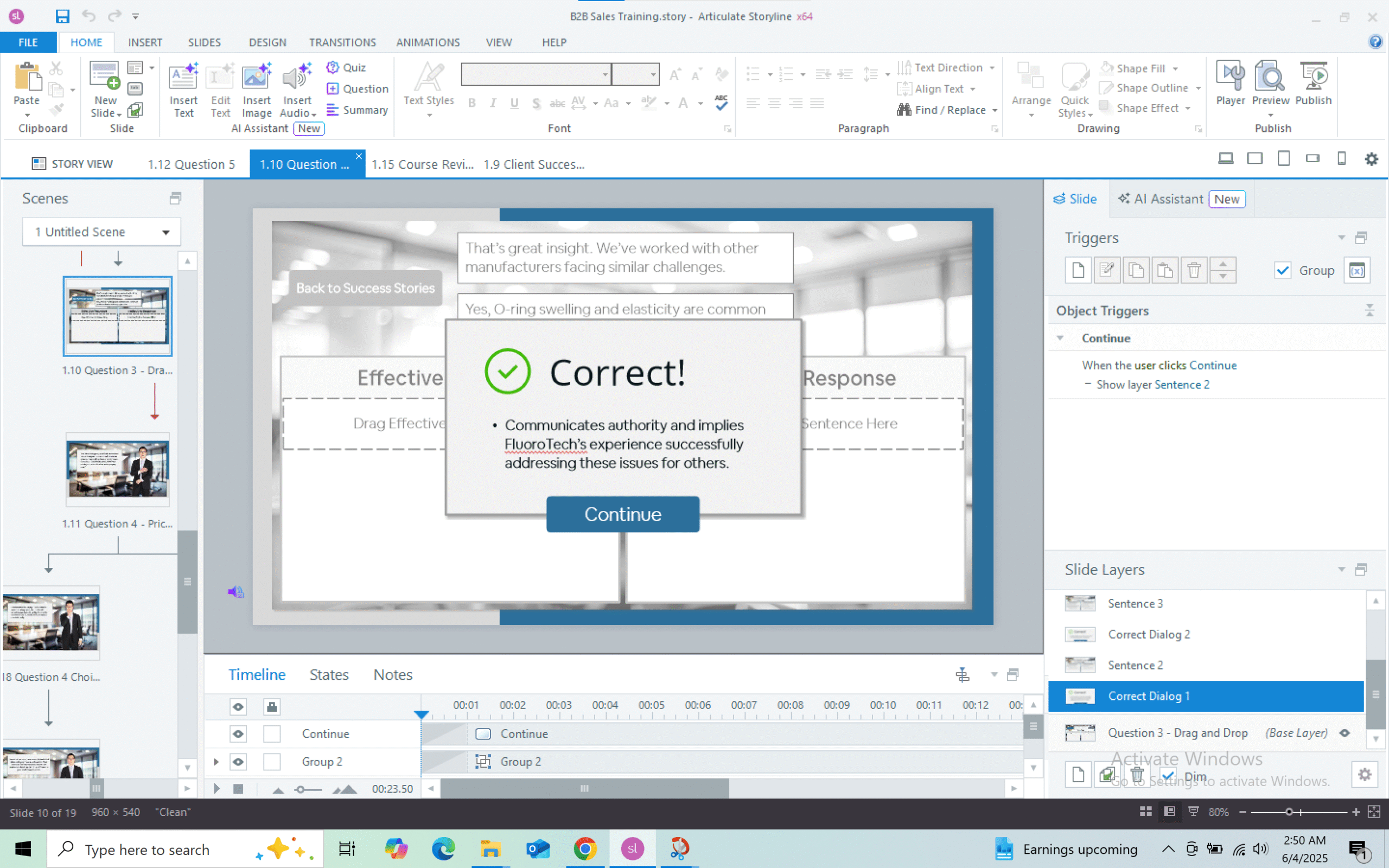
The scenario was structured to present learners with realistic consequences for their choices. They would immediately see how prospective buyer might respond to their approach, followed by feedback from the course narrator explaining why the buyer reacted that way and what the learner did well or could improve. This design enables learners to explore real-world outcomes in a safe, risk-free environment.
I sought feedback from the SME to ensure the scenario aligned with the first course objective and FluoroTech’s overall business goal. Based on their input,, I revised the scenario before drafting those for the remaining four objectives. After incorporating final feedback on the full set of scenarios and receiving SME approval, I began designing and developing a prototype of the first scenario in Articulate Storyline 360.
Visual Design
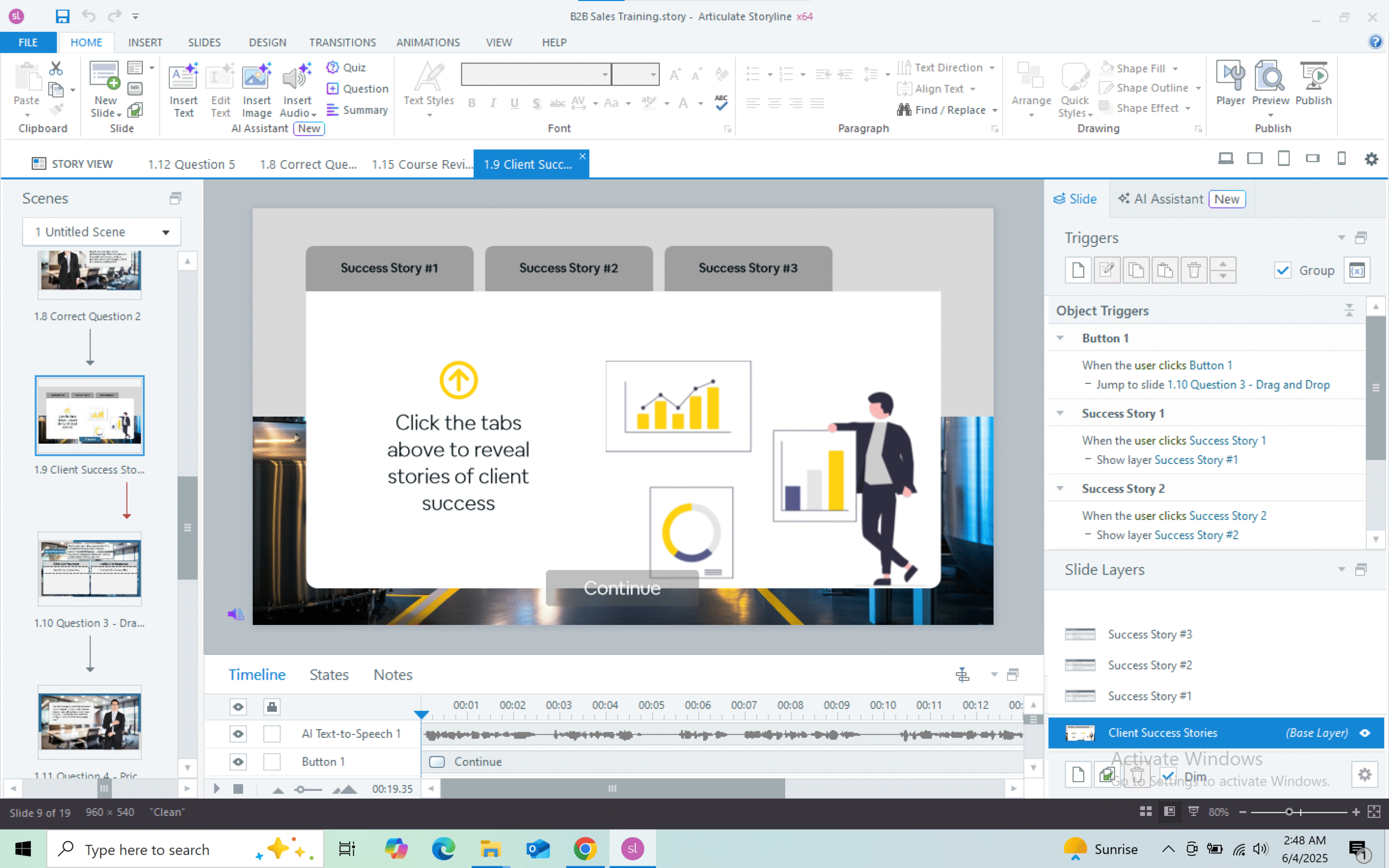
I began the visual design phase by developing settings that supported the course’s subject matter while maintaining a clean, professional aesthetic. For the introduction and conclusion slides, I used an industrial backdrop that aligned with the target industry, reinforcing the course’s real-world relevance. For the scenario slides, I chose a modern office environment with muted, warm tones to reflect the course’s professional tone and provide a realistic setting that wouldn’t distract from the content.


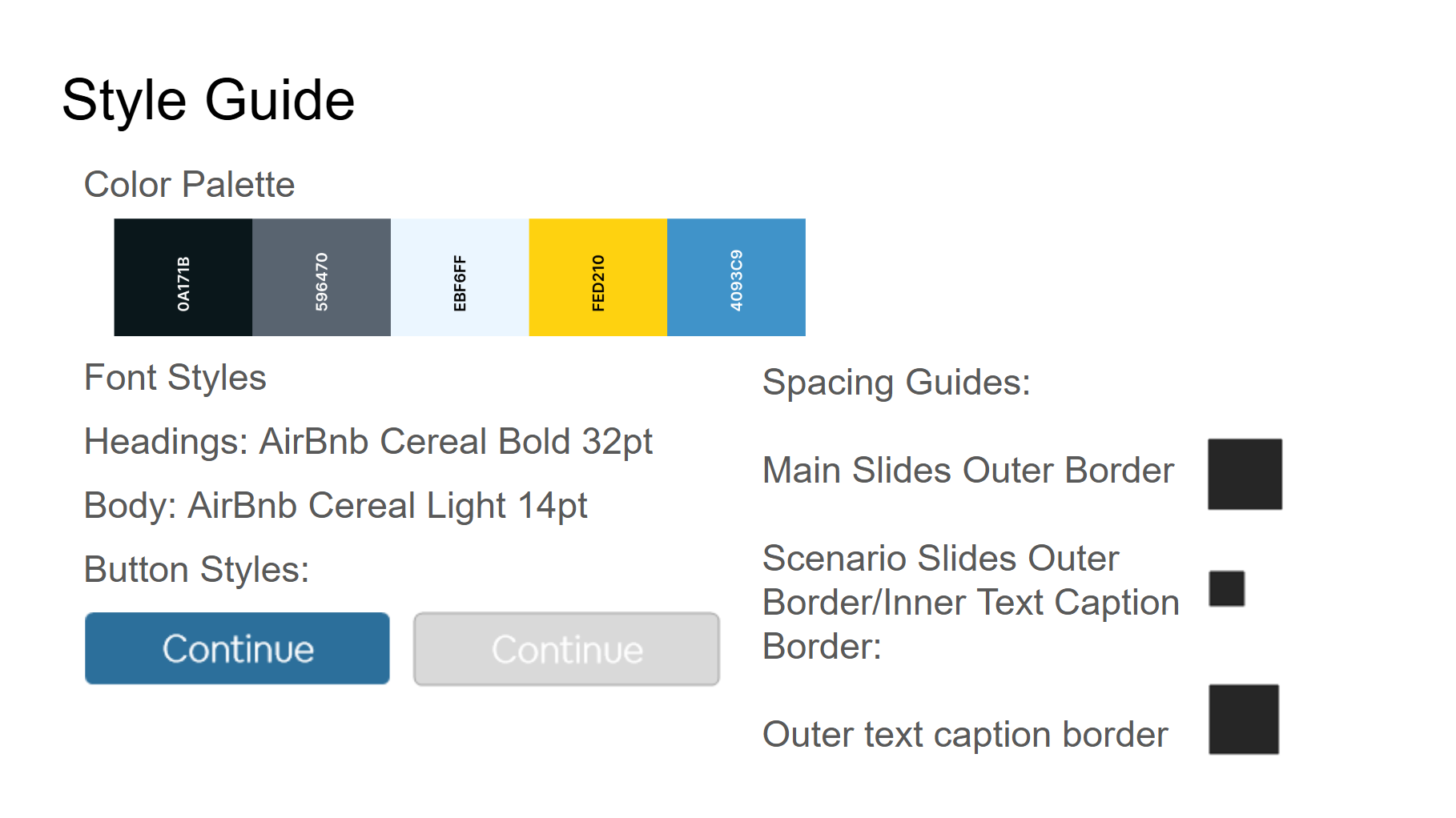
From these visual foundations, I built a cohesive color palette that complemented the industrial theme and applied it consistently across all course elements. This unified design contributed to a polished, professional look and reinforced the course’s tone and branding.

To further support learner engagement, I included a prospective buyer character that aligned with the workplace setting and felt authentic to the target audience. The character’s appearance and demeanor helped reinforce the course’s tone and subtly guided learners in choosing appropriate responses throughout the scenario.
Interactive Prototype
After establishing the visual style, I used the revised storyboard to build a prototype scenario in Articulate Storyline 360. The prototype included an introduction to the course objectives and one fully developed scenario featuring branching paths that reflected different learner choices and their consequences.
Once the prototype was complete, I shared it with the subject matter expert (SME) to gather feedback on both content accuracy and overall flow. I refined the prototype and proceeded with full development of the remaining scenarios. Because I had laid a strong foundation and gathered feedback throughout the analysis and design phases, the development process went quickly and smoothly.
Reflection and Takeaways
This project offered valuable opportunities to grow as an instructional designer by expanding my design skills. Because the course content was based in an industry unfamiliar to me, I had to quickly get up to speed and rely heavily on collaboration with a subject matter expert who works in the fluoroelastomer compounding industry. This required me to ask the right questions, interpret technical information accurately, and translate it into effective, learner-centered content. I hadn’t needed to apply these skills in the same way as a teacher.
The project did also require me to further hone and adapt skills that I have developed as an educator, such as critical reflection, problem-solving, and a willingness to receive and apply feedback.
One of the most important lessons was the value of investing time in the needs analysis and design phases. By clarifying business and course goals early, I was able to identify high-priority performance gaps and ensure the learning solution stayed aligned with both business objectives and learner needs. This groundwork made the development phase more focused and efficient.
I also came to appreciate the power of authentic, visually cohesive learning environments. Drawing on my experience engaging students, I designed a realistic and intuitive interface that supported immersion and minimized cognitive load.